LEGAL CHECKLIST FOR WOULD-BE DEVELOPERS
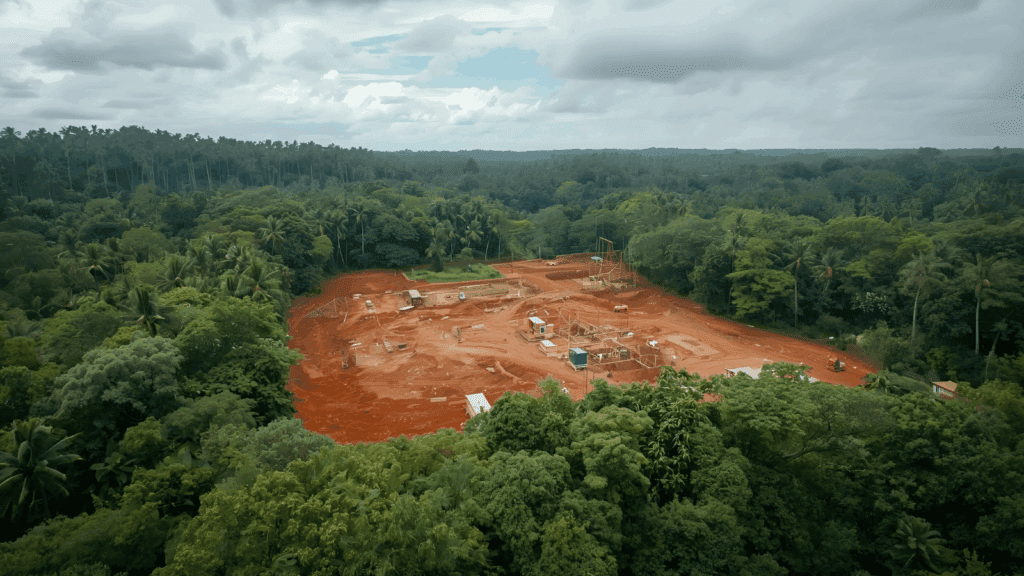
OSA VIVE’S (PARTIAL!) LEGAL CHECKLIST FOR WOULD-BE DEVELOPERS OSA VIVE’S (PARTIAL!) LEGAL CHECKLIST FOR WOULD-BE DEVELOPERS Osa Vive demands that developers respect Costa Rica’s environmental laws and we hold them legally accountable when they don’t. To help would-be developers respect the law and avoid fines, delays and jail time, we offer this partial list of questions to help developers (and investors) with their due diligence. Osa Vive’s attorneys know all the answers; attorneys working for developers should too. Costa Rica’s legal philosophy Article 50 of the Costa Rican constitution plainly states:“All persons have the right to a healthy and ecologically balanced environment.For that, they are legitimated to denounce the acts that infringe this right and to claim reparation for the damage caused. The State will guarantee, will defend and will preserve this right. The Law will determine the responsibilities and corresponding sanctions.” Do you know Article 50 has been used in environmental claims against irresponsible developments?Do you know that Costa Rican environmental law respects the “Precautionary Principle” meaning that it is the responsibility of developers to prove that their development will not harm the environment, rather than the responsibility of the government or environmental organizations to prove that the development will cause harm? Changes to forested land Forest Law 7575 contains many powerful and important provisions, including criminal penalties (jail time). The law contains a formal and technical definition of forest (it’s not just someone’s opinion) and prohibits the change of the use of land (cambio de uso del suelo) from forested to something else, like a housing development. The law provides for a small number of exceptions – for example, for an ecotourism project or for water management projects needed to maintain the integrity of the forest. Some developers believe that it is legal to change 10% of the land from forest to development; this is the so-called “10% rule.” But that is a fundamental misreading of the law. There is simply no such thing as a 10% rule that allows developers to change 10% of their forested property into a development. Osa Vive is working on such a case now. Don’t go there! Do you know that penalties for changing the use of the soil include destruction of any buildings constructed? Did you know that years of jail time are on the table for those who change the use of the soil? Consider yourself informed. Water resources Water resources (springs, wells, streams, including intermittent/temporary streams, ravines, ground water recharge areas, legal concessions) are surrounded by protected zones (zonas prohibidas) where earth cannot be moved, trees cannot be cut and development cannot occur. The extent of those protected zones around water resources ranges from 15 meters on each side up to 200 meters of radius, and varies with the steepness of the terrain, the type of resource (well vs spring vs stream), and whether the water is used by ASADA to supply a local community. Have you mapped every water resource on the property you want to develop? Have you overlaid those resources with appropriate protected zones to see how much land is actually legally available for development? Better be sure ahead of time, because the truth will come out if Osa Vive gets involved. Roads Are you planning to use an existing road, or a remnant of an old road, or build a new road? There are a lot of pitfalls regarding roads. If a road crosses property that is not yours, do you need written permission to use, modify or expand the road? Does it cross through the protected zones mentioned above associated with water resources, or forest resources? Does it cross through a wildlife corridor? If so, various government regulations may be triggered – be prepared. Do you know that if an old farm road has fulfilled its original purpose (eg, for agriculture) the road may be subject to termination? Maritime zone Do you know that within the MZ there can be no development unless the government grants concessions? Do you know that the government can revoke those concessions at their discretion? Do you know that there can also be Protected Areas within Maritime Zones where no concessions can be granted? Moving earth Do you know that a permit is needed to move earth if you are moving more than X cubic meters? Do you know what X is? Do you know the penalties for moving earth without a permit? Do you know how moved earth must be disposed of and the penalties for not disposing of it properly? Wildlife corridors and protected species Are you aware of the boundaries of the Corredor Biológico Paso de la Danta, and other wildlife reserves and corridors? Do you know the special regulations associated with that corridor? Do you know the penalties associated with violating those regulations? Permits Clearly developers need legal permits to do pretty much anything associated with developments.But take note of several important facts regarding permits: Permits granted to one applicant might not be transferable to a subsequent owner.Not all permit applications are granted.3) Permits that have been granted may be improper and can be challenged. And Osa Vive has challenged, and is challenging, the legality of many permits. We challenge improper SETENA authorizations, improper MINAE/SINAC permits, improper Muni permits. We use our legal team. We work with the Osa Fiscal. We file legal challenges with every applicable part of the Costa Rican Court system. Those legal challenges cost developers time and money. So the wisest course of action would be for developers to have their attorneys be as scrupulous as possible – as scrupulous as Osa Vive is – when applying for permits so that there is nothing left for Osa Vive to challenge. Developers will save time and money, and perhaps even sleep better at night knowing that they are respecting the laws passed by the elected representatives of the Costa Rican people. Consequences Penalties for violating the law include financial penalties (fines), restoration of destroyed habitat (time consuming and expensive) and criminal
The Costanera Billboard Project: A Message in Three Parts

The Costanera Billboard Project: A Message in Three Parts Osa Vive recently installed a series of three bilingual educational billboards along the Costanera highway between Ojochal and Uvita. Why? Because sometimes, you have to fight bulldozers with big signs. Why This Matters Costa Rica is a global gem: breathtakingly beautiful, fiercely peaceful, wildly biodiverse, and full of kind, proud people. The Southern Zone in particular is like nature’s VIP lounge—monkeys swinging overhead, toucans arguing in the trees, coral reefs shimmering offshore, and culture that pulses with life. It’s no wonder people from around the world come here seeking the magic. And when tourism is rooted in sustainability—eco-lodges, cultural immersion, forest hikes, reef snorkeling—it supports the local economy and protects the very things people come to experience. But not everyone comes here for sloths and sunsets. Some come chasing one thing: MONEY. Where you might see a pristine forest full of life, these folks see “undeveloped land with ocean views.” To them, it’s all potential profit—trees, animals, communities be damned. Billboard #1: PURA VIDA? We all know the phrase. Pura vida means “pure life”—a celebration of Costa Rican culture, joy, nature, and community. But lately, it’s starting to feel like “loving something to death.” In the name of “development,” forests are being clear-cut. Wildlife is losing its home. Hillsides are scraped down to clay, causing erosion that clogs rivers and suffocates coral reefs. It’s not development—it’s destruction dressed up in tropical real estate brochures. Developers are selling a dream. But if you look closer, it’s more like a scam. Billboard #2: OVERDEVELOPMENT DESTROYS NATURE… AND RAISES COSTS FOR LOCALS Yes, cutting down forests harms the environment. That much is obvious. What’s less obvious is how overdevelopment dries up more than just creeks—it dries up opportunities for locals. Fewer trees mean less rain. More visitors mean more water use. Suddenly, the once-abundant Southern Zone is facing shortages. (Locals collecting water in Guanacaste. Credit: Tico Times) And while large-scale projects might create a few temporary construction jobs, many of those go to people who are not local or are even from other countries like Nicaragua. The long-term jobs left for locals? Often low-paying roles in gardening or cleaning, with little upward mobility. Meanwhile, who benefits? Investors. Wealthy developers. People rich enough to build luxury homes in someone else’s paradise. These folks aren’t hurting—but their projects hurt everyone else. Need proof? Look at Guanacaste. It’s filled with resorts, and also one of the poorest regions in the country. Locals there are being priced out of their own towns. The same is already starting to happen here in the Southern Zone. High-end developments don’t lift up communities—they push them out. Billboard #3: LET’S PROTECT FORESTS, COMMUNITIES, AND WATER Here’s the deal: once these habitats are gone, they’re gone. Once living costs skyrocket, people can’t afford to come back. There’s no “undo” button. Tourists don’t fly here to see condos. They come for waterfalls, howler monkeys, and jungle trails. They want the real Costa Rica, not a gated community with imported palm trees. And Ticos are pushing back. In Samara, a community just blocked a massive development project. Nationwide, citizens are standing up to gentrification and fighting to keep their land, culture, and environment intact. But this fight isn’t over—it’s just beginning. Guanacaste is already overbuilt. Let’s not let the same thing happen here. What Can We Do? We need to rethink what “luxury” really means. Is it a marble countertop with a view, or waking up to toucans and the smell of rainforest? Is it exclusivity—or authenticity? Even global artists like Bad Bunny are calling out the dangers of this trend. His song “El Apagón” talks about how irresponsible development has devastated Puerto Rico and Hawaii. Sound familiar? It’s happening here, too. We believe that development should benefit locals—not displace them. It should create opportunities and protect the environment, not exploit both. That’s why we support Tico-owned businesses that preserve the land and promote eco-tourism. That’s the path forward. How You Can Help We say NO to irresponsible development.We say YES to sustainable tourism.And we ask visitors: Protect the communities and ecosystems you came to see. Osa Vive works hard to fight back—legally. We research, file claims, review permits, and do environmental impact assessments. But all of that takes money. The number of projects we can take on depends directly on the resources we have. So if you love this region—and want to see it stay wild, vibrant, and affordable for the people who call it home—please help: 👉 Become a member👉 Donate if you can: osavive.org/donate👉 Follow us and share the word Together, we can make sure Pura Vida stays pure. Are you looking to get involved? Below are ways you can help! Donate Volunteer
OSA VIVE JOINS 1% FOR THE PLANET
OSA VIVE JOINS 1% FOR THE PLANET —ENGLISH VERSION BELOW— Osa Vive se complace en anunciar que nos hemos unido a 1% for the Planet como Socio Ambiental Verificado. Las donaciones que recibamos a través de esta colaboración aumentarán nuestro impacto e involucrarán a más empresas en el movimiento ambiental. 1% for the Planet es un socio responsable para las empresas que rechazan la rutina y se comprometen a apoyar a Socios Ambientales Verificados que marcan la diferencia en todo el mundo. Fundada en 2002 por Yvon Chouinard, fundador de Patagonia, y Craig Mathews, fundador de Blue Ribbon Flies, sus miembros han donado cientos de millones de dólares a Socios Ambientales hasta la fecha. Las empresas miembro donan el 1% de sus ganancias cada año a Socios Ambientales Verificados, como Osa Vive. “El objetivo de 1% for the Planet es ayudar a financiar estas diversas organizaciones ambientales para que, colectivamente, puedan ser una fuente más poderosa para resolver los problemas del mundo”, escribe Yvon Chouinard, cofundador de 1% for the Planet. Queremos agradecer a Liquid Blue, la primera empresa miembro del 1% en realizar una generosa donación a Osa Vive a través del programa 1%. Nos honra contar con su apoyo. Si forma parte de una empresa miembro del 1%, conoce a alguien que lo sea o desea animar a alguien a unirse al programa, asegúrese de informarle que Osa Vive ahora es un Socio Ambiental aprobado al que puede donar. Gracias por su compromiso y apoyo. Osa Vive is pleased to announce that we have joined 1% for the Planet as a vetted Environmental Partner! The donations we receive through this partnership will increase our impact and involve more businesses in the environmental movement. 1% for the Planet is an accountability partner for businesses that reject business as usual and commit to supporting vetted Environmental Partners that are making a difference around the globe. Started in 2002 by Yvon Chouinard, founder of Patagonia, and Craig Mathews, founder of Blue Ribbon Flies, their members have given hundreds of millions of dollars to Environmental Partners to date. Member businesses donate 1% of their profits every year to vetted Environmental Partners, like Osa Vive. “The intent of 1% for the Planet is to help fund these diverse environmental organizations so that collectively they can be a more powerful source in solving the world’s problems,” writes Yvon Chouinard, co-founder of 1% for the Planet.” We would like to give a shout out to Liquid Blue, the first 1% Member business to make a generous donation to Osa Vive through the 1% program. We are honored to have earned their support. If you are a part of a 1% Member business, know someone who is, or want to encourage someone to join the program, please be sure to let them know that Osa Vive is now a vetted Environmental Partner to which they can donate. Thank you for your commitment and your support.”
OSA VIVE’S YEAR IN REVIEW

OSA VIVE’S YEAR IN REVIEW —ENGLISH VERSION BELOW— RESEÑA DEL AÑO DE OSA VIVE ¡2024 ha sido un año increíble para Osa Vive! Siga leyendo para conocer lo que hemos estado haciendo y cómo puede ser parte de nuestros esfuerzos para detener el desarrollo irresponsable en el delicado ecosistema de la Zona Sur de Costa Rica. Costa Rica tiene leyes ambientales sólidas destinadas a proteger los remanentes hídricos y los bosques. Costa Rica también tiene un sistema judicial sólido. El eslabón débil es la aplicación de la ley: El país simplemente no tiene los recursos para buscar infracciones y hacer que los infractores rindan cuentas en los tribunales, especialmente dada la enorme cantidad de proyectos en marcha. ¡Pero Osa Vive sí los tiene! Somos ese eslabón de rendición de cuentas que falta y estamos orgullosos de hacer lo que podemos para apoyar la aplicación de las leyes ambientales existentes en Costa Rica. Lo Más Destacado de 2024 Exponiendo “El Proyecto Dominical” El equipo legal de Osa Vive ha estado investigando los permisos y otros aspectos legales de este proyecto verdaderamente terrible de $700 millones, y nuestro equipo de redes sociales está publicitando sus muchos elementos devastadores y promesas vacías inconsistentes. ¿Se imagina un megaproyecto de 2.000 camas al lado de un pueblo con apenas 400 habitantes? ¿Qué tal una planta desalinizadora que arrojará salmuera concentrada directamente al océano, además de una planta de tratamiento de aguas residuales en medio de la Zona Marítima? ¿Qué opina de la demolición de bosques primarios, hábitats de vida silvestre y humedales sensibles, todo para generar ganancias para unos pocos inversionistas? Hemos creado un sitio web dedicado a compartir los detalles oscuros del Proyecto Dominical: consulte los artículos de Noticias y Análisis en la parte inferior de la página de inicio. También estamos compartiendo estos recursos en el blog de Osa Vive. ¿Eliminación Gradual de la Fase 11? ¿Y la 12? Este año, Osa Vive obtuvo un fallo judicial sobre un proyecto de Ojochal, creativamente llamado Fase 11, desarrollado por Ventana del Pacífico. Nuestro equipo legal, dirigido por Edgardo Araya, uno de los abogados que ayudó a cerrar la mina de Crucitas, afirmó que el desarrollo requería un permiso ambiental especial de la SETENA que no se solicitó ni se recibió. ¡Y el tribunal estuvo de acuerdo! De hecho, el tribunal también dictaminó que la municipalidad: (1) debe realizar una investigación interna para averiguar por qué no siguió los procedimientos correctos, y (2) podría tener que pagar por los daños ambientales. Hemos informado al fiscal ambiental de Osa, Camilo Flores Pacheco, sobre este caso. Si considera que hubo corrupción u otra conducta delictiva, tiene la opción de iniciar un proceso penal. Este gran resultado demuestra una vez más que Costa Rica tiene buenas leyes y un buen sistema judicial. ¡Estamos seguros de que la municipalidad no volverá a cometer el mismo error! El equipo de Osa Vive tiene un segundo caso legal relacionado con un proyecto Ventana del Pacífico en curso. Este grupo quiere desarrollar una gran propiedad que llaman, ¿adivinen qué?, Fase 12. Quieren crear lotes para alrededor de 400 casas entre la carretera principal de Ojochal y la calle de Cinco Ventanas. Pero Osa Vive cree que la propiedad, una finca de más de 100 hectáreas que ha estado abandonada durante muchos años, había alcanzado un estado forestal (antes de que lo quemaran hasta las raíces, ¡una historia para otro momento!) y, por lo tanto, estaba protegida del desarrollo por el principio de “uso del suelo” de Costa Rica: Básicamente, la tierra no se puede cambiar de una cosa a otra, en este caso de bosque a casas. Actualmente, está en vigor una orden judicial contra todo desarrollo en la Fase 12. Un equipo de técnicos debe venir al sitio y hacer mediciones, examinar fotografías aéreas, y determinar si el terreno había alcanzado el estado de bosque. Ya veremos, pero por ahora el desarrollo allí se ha detenido oficialmente. ¡Nos encantaría que Ventana del Pacífico convirtiera la Fase 12 en un parque público para que todos los habitantes de Ojochal disfruten! Difundiendo la Palabra Denuncia SITADA: Osa Vive se enorgullece de haber producido un folleto, “Cómo y por qué denunciar daños ambientales”, para descarga gratuita en inglés o español. Los lugareños preocupados están utilizando esta guía para exigir cuentas a los infractores. Nos alegra ver que los miembros de la comunidad toman medidas para proteger el medio ambiente y estamos felices de brindar este recurso para presentar denuncias o querellas penales. Celebrando el éxito: Esté atento a nuestra nueva serie de redes sociales “Historias de éxito” próximamente. Cada historia detallará cómo Osa Vive y otro grupo de personas preocupadas frenaron o detuvieron un desarrollo perjudicial. Compartir estas victorias es clave: el público necesita saber que Costa Rica tiene leyes sólidas que no se pueden ignorar. Los desarrolladores también deben estar al tanto de cuántos proyectos se han detenido por razones legales. Estos ejemplos deberían hacerlos reflexionar: ¡La Zona Sur de Costa Rica no es un lejano oeste donde todo vale! Carteleras publicitarias por una causa: también estamos muy entusiasmados con nuestro plan de comenzar a instalar carteles publicitarios educativos provocativos en la Costanera Sur. Consideramos que estos carteles son una forma eficaz de recordarle al público que el área es un corredor de vida silvestre lleno de animales; no es el lugar para talar el bosque para construir proyectos de lujo masivos que son malos para la vida silvestre y para la comunidad. Esperamos ayudar a cambiar la conversación y las expectativas locales, y queremos que los potenciales desarrolladores no se sientan desanimados. Tal vez sus proyectos no sean tan bien recibidos por la comunidad como pensaban (¡si es que siquiera pensaron en eso!)…Tal vez con los grupos ambientalistas observando cada uno de sus movimientos, será más difícil, más costoso, y más lento desarrollar de lo que pensaban…Y tal vez, considerando todo, arriesgarse a la destrucción de este lugar mágico para ganar unos dólares simplemente no vale la pena. Capital social: Osa
The plans that could destroy a mountainside forest
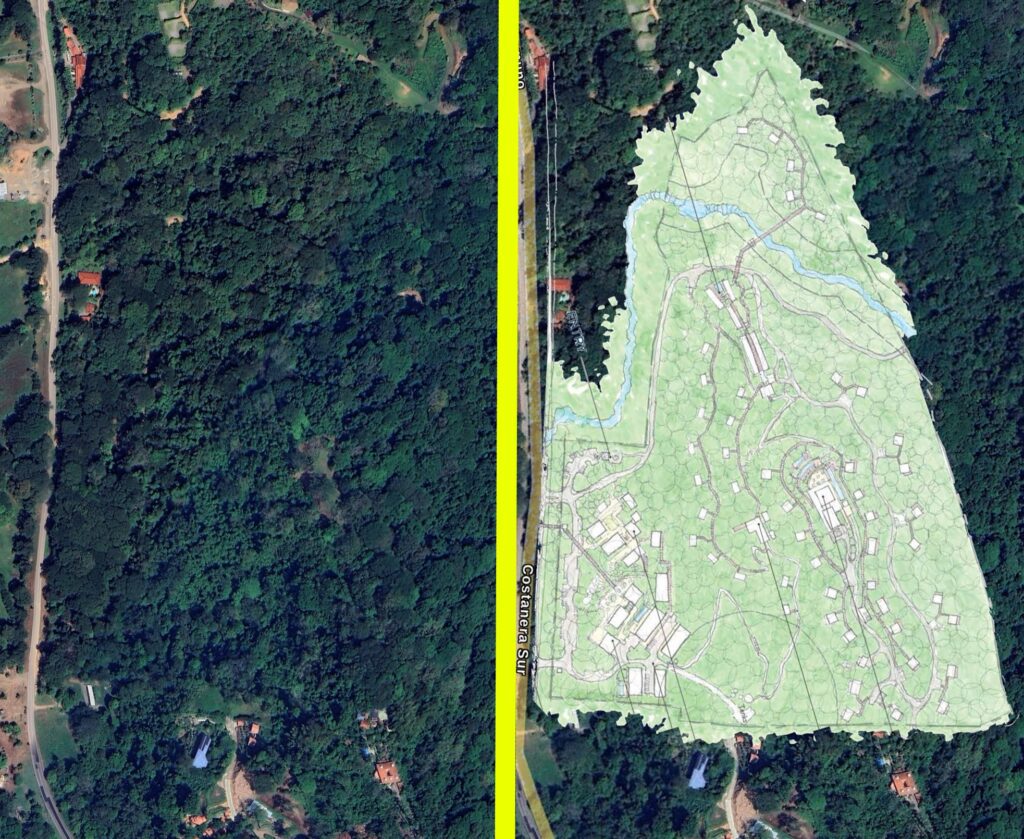
The plans that could destroy a mountainside forest The Dominical Project is a proposed $700 million mega project, planned to be built in and around Dominical. The project is split into two main parcels: Dominical Ridge, a 60 acre forested site on the mountain above Dominical, and Playa Dominical, currently pastured land, south of town. On Dominical Ridge, the proposal is to build up to 90 luxury housing units, and a high end luxury hotel on the ridge. Looking at their plan, shown below, it’s clear that many trees would have to be cut in order to carry out this construction work. What isn’t as immediately obvious is the amount of destructive reshaping of the mountain that the developers deem necessary. This is the story of how we discovered the extent of the horror that is planned. At the beginning of the last dry season, approximately two acres of land on the Dominical Ridge property were cleared of undergrowth, many trees cut, and most of the area graded. Several building plantels with reinforcing rock embankments were installed, and a short section of road was constructed. This all took place on the part of the “Dominical Project” property that is currently classified as “mature forest” but is slated to host a super-luxury hotel and somewhere between 30 and 92 luxury houses. This is only a small portion of the property, and the developers clearly are not quite ready to kick the whole project off. That led us to ask why this work had been initiated. We began to investigate. Read More
A $27 million museum in Dominical?

A $27 million museum in Dominical? The $700 million Dominical Project has many shocking elements: four luxury hotels totaling 500 beds plus 450 condos, town houses, and villas adding another 1,000 or so beds to a town with 400 people. A wastewater plant in the Maritime Zone. A desalination plant. You can read the details here. But wait, there’s even more: How about a three-story $27 million museum? OK, let’s be fair. Museums can be good things. Visitors can learn about art, history, culture and nature. Spending time in a museum can be very enriching and enlightening. And one could even imagine that a museum might have a positive effect on the local economy. It could, maybe, bring in tourists who would sleep in local hotels, take local tours and eat at local restaurants. Maybe…. But there are other factors to consider. First, location. Developers Yoder et al propose to put the museum in an area south of town that is currently bucolic seaside pastures. There is also a question about whether this area is currently or was formerly designated as a wetland. That is not the right place for a three-story museum. Second, if their goal was to help the community, would a $27 million museum be the best way to accomplish that goal? Seems pretty unlikely. How about asking the local business owners and community leaders what they would do with $27 million? Pretty sure they would have some great ideas about how to help the community. For example, how about building some affordable housing? We are willing to bet that if the community had $27 million to spend it would not be spent on a museum. And finally, consider the context. If Yoder et al were proposing to build only a museum, one could look at their proposal in a more positive light and give them the benefit of any doubt one might have. Maybe they really do want to help the community by building a tourist attraction. Alas, no. Their plan to build luxury hotels, villas and more (including in 60 acres of mature forest) would absolutely dominate and destroy existing businesses in Dominical, to say nothing of its unique vibe. For whatever reason, they also stuck a museum in their proposal, maybe to soften the overall blow. Earlier this year, Osa’s environmental attorney general Camilo Flores gave an interview in which he described the large developments that were being planned in this area as equivalent to “neocolonialism”, with the influx of capital from richer nations leading to the spiraling of real estate prices, threatening to put land and housing in the desirable Dominical and Uvita areas out of reach of local residents. When America’s OG colonialist, Columbus, landed on the shores of North America, his intentions were not exactly altruistic. He wanted to acquire riches and he didn’t care what happened to the local people in the process. But he was clever. He described his strategy for getting what he wanted: “I gave them many beautiful and pleasing things, which I had brought with me, for no return whatever, in order to win their affection…and that they might be eager to search for and gather and give to us what they abound in and we greatly need.” His strategy worked then. But now people are wise to that strategy. So, thanks for offering the museum, guys, but no thanks.
The Developers who want to own Dominical

The Developers Who Want To Own Dominical What can we learn about the developers through their language to investors? The Dominical Project is a proposed $700 million mega project, planned to be built in and around Dominical. Developers, like realtors, have cliches that they like to fall back on in their promotional material. In the southern zone of Costa Rica, near 100% of proposed developments are described as being “sustainable”, in harmony with nature, and “eco” of some kind or another. Most of them boast about the area’s rich biodiversity, all the while proposing to cut into the ecosystems that host this biodiversity in order to replace them with villas and pools. Wild ecosystems are not sustained by converting them into luxury housing. The developers of The Dominical Project go a little further than most, and we thought it worth highlighting some of the quotes from their investor materials. The Dominical Project offers a unique opportunity to create a world-class tourism destination, a master-planned beachfront community, and a global model for sustainable development in one of the most spectacular, bourgeoning and underserved regions of Costa Rica A slice of Escazu transported to the beach doesn’t “create” Dominical as a world-class tourism destination. And there is very little in the plans that suggests that the proposed project even approaches being a “global model for sustainable development”. Demand from regional and foreign and markets is growing while top tier hotels, homes and services remain in limited supply. Seizing the opportunity to cater to this growing market, Osa Development launched a comprehensive strategy to activate the Southern Zone through the acquisition and thoughtful development of the region’s most prime parcels. Osa Development have been trying to get this project off the ground for years. When they started, it’s certainly possible that there was limited supply. That is no longer the case. In any event, the Southern Zone does not need to be “activated” – if anything, the unique charms (and biodiversity) of the Southern Zone are more at risk than ever of being obliterated by thoughtless and generic development. The area presents numerous tourism attractions that offer a compelling alternative to the country’s less lush and more developed Northern Zone. More than twelve national parks are easily accessible from The Dominical Project, including the Osa Peninsula, named “the most biologically-intense place on earth” by National Geographic. With the help of The Dominical Project, the Southern Zone and the town of Dominical have the potential to become one of the most desirable destinations in Costa Rica. A double dose of irony in this paragraph. First, the developers praise the Southern Zone for being less (over) developed than Guanacaste, all the while planning a Tamarindo style development for the area. Secondly, they sing about the Osa Peninsula’s rich biodiversity, and then turn around and propose a master-plan that would add anywhere from 60-90 new luxury housing and hotel buildings throughout a 65 acre parcel of rainforest, effectively neutralizing its ecosystem. In order to establish Dominical and the Southern Zone as a highly desirable destination and globally recognized model for sustainable living, the Team has implemented a multi-phased strategy for activating the region, beginning with a carefully conceived beachfront town and anchor hotel that preserves the natural heritage and integrity of the area, while celebrating the local surf and music culture. Again with “activating”, and newly with “establishing” the area as desirable. We’re pretty sure it already is! We’ve already called attention to the sustainability claims. And while we’re sure that the capital T Team’s strategy has been well considered, all indications are that it starts with clearing forest and ends with selling houses – not a whole lot of “preserving” to be found in the pages of their investor materials. The Dominical Project is poised to fill the market’s unmet demand for meaningful experiences and comfortable lodging in the Southern Zone. Currently, the limited number of hotels that exist are “Mom and Pop” operations… There are hundreds of rental villas in the area between Dominical and Uvita. While it may be true that during Christmas and New Year’s that everything is booked up, for much of the year a sizable proportion of that inventory sits empty for much of the time. Nothing in the investor portfolio speaks to the project creating “meaningful experiences”, other than perhaps the proposal for a $27 million museum. And by “Mom and Pop operations”, we understand the developers to be critiquing owner operated hotels – which, again, are part of the charm of the area, which apparently the developers fail to understand. The Southern Zone’s mountainous topography, lack of significant remaining beachfront parcels, and prior limited access, allow The Dominical Project’s portfolio of properties the ability to capture and define the premium hospitality market. Capture and define. The Team’s initial focus will be the development of three branded beachfront hotels that create a strong sense of destination for Dominical…Once the anchor destination for Playa Dominical and the new town center has been launched with the first boutique hotel, the Team will begin the buildout of the elements of a livable year-round community built on a strong tourism base. Leaving aside the question of how the addition of three chain hotels will “create” a sense of destination, the developers aren’t shy about imagining their project as becoming the “center” of Dominical. What would that mean for existing businesses, no longer part of the “center”? The developers plan to build 450 new houses and 500 hotel rooms in a town with a population of just 400. While their claims of “sustainability” appear to be just empty marketing fluff, they have been very clear about one thing: they fully intend to own the economy of Dominical. Existing hotels will be in trouble. Any tourism businesses outside of the new “center” will have to scramble to keep up. An even higher percentage of existing vacasas and airbnbs will sit empty, for more of the year. Dominical has historically attracted many such would-be empire builders, and has
Arrested SETENA Official Was Involved In Approving Megaproject “The Dominical Project”

Arrested SETENA Official Was Involved In Approving Megaproject “The Dominical Project” On June 19, 2024, agents of the Judicial Investigation Agency (OIJ) conducted raids on the offices of SETENA, an agency involved in granting building permits to developers. Among those arrested was Ulises Alvarez Acosta, on suspicion of influence peddling and other crimes – in other words, taking bribes in exchange for streamlining the review process. (Investigations are ongoing, and no trials have yet taken place). Independent analysts working with Osa Vive, a Costa Ballena based conservation non-profit, discovered that Senor Alvarez had been involved back in 2022 in approving environmental impact assessment documents for a controversial $700 million luxury development (The Dominical Project) planned for Dominical, otherwise known as a surfing village. The documents submitted to (and approved by) SETENA reference a budget that’s at least $300 million less than the budget promoted to potential investors, which appears to be a significant irregularity. While the reasons for this discrepancy can only be speculated about given currently available information, it’s worth noting that SETENA requires a deposit of 1% of project costs, meaning that if the developer had submitted the full budget discussed with investors, they would have had to pay an additional $3 million during this permitting process. Osa Vive believes that the current Environmental Impact Assessment (EIA) should be nullified, and that The Dominical Project should be required to apply for a new EIA that will be free from suspicion of irregularity. Until there is a new EIA, or an external audit of the assessment is completed, we believe that all aspects of The Dominical Project should be put on hold.
The Dominical Project
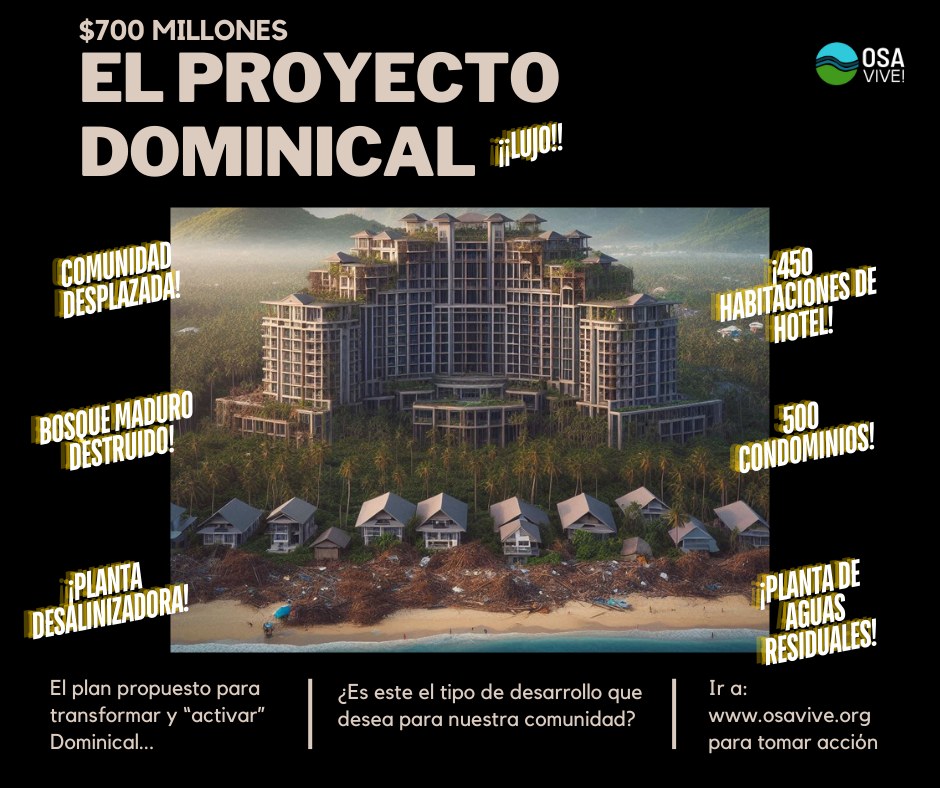
Have you heard about the plan to transform Dominical? Developers propose spending $700 million in Dominical on four luxury hotels plus condos, townhouses and villas totaling 1 or 2 thousand beds in a town of 400 people. Construction would occur near former wetlands and in mature forest. Osa Vive has been investigating the details and permits of this project. We have also been working closely with community members in Dominical to find out what they think. We have not found much support for this gargantuan project. Osa Vive believes that communities should have a say in how their area develops. We have been posting information about the project on social media to educate the public. We are pleased that our posts have generated a lot of discussion. You can see the comments folks made about the project and maybe share your thoughts by clicking here to see the first Facebook post we made on this project: View Facebook Post You can also see our posts on Instagram @osavive You can learn much more about “The Dominical Project” at a special website devoted just to that topic: thedominicalproject.com Osa Vive will continue to uncover and share information about major projects with the public. We are also committed to continuing our legal work including scrutiny of permits and taking legal action against environmental lawbreakers. Osa Vive is a 100% non-profit registered in Costa Rica. Nobody at Osa Vive gets paid. But we do need funds to do this work: to pay lawyers, to boost social media posts, to print fliers, and more. If you would like to support what we do please join us, volunteer your time, and stay informed with our newsletter. https://osavive.org/get-involved/ If you are able to make a financial contribution, you can do so here: https://osavive.org/donate/ The future of the Southern Zone is in our hands. We will not stand by and watch monied interests destroy the environment and steamroll local communities. Together, we can do this.
Dominical’s Water Crisis: The Shocking Truth Behind the Illegal Development Project
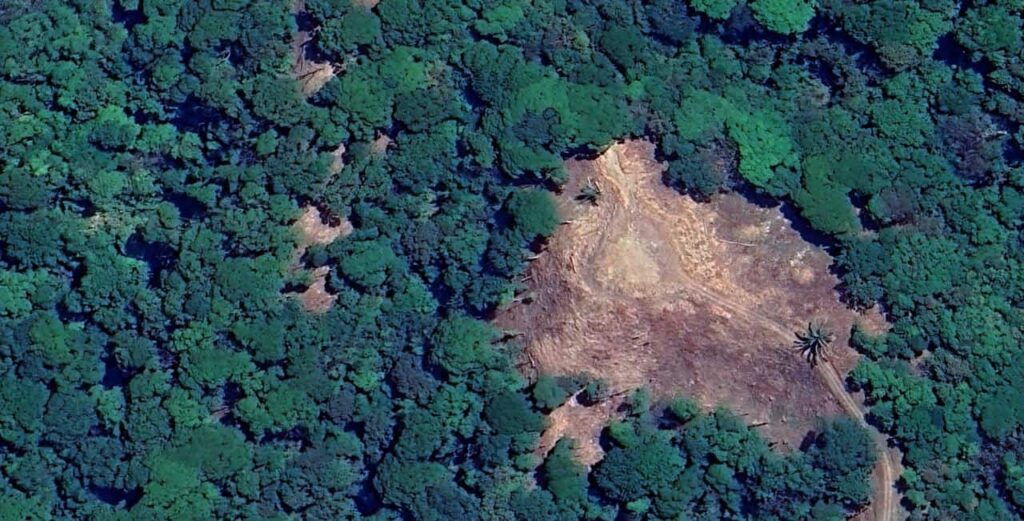
Dominical’s Water Crisis: The Shocking Truth Behind the Illegal Development Project Originally Posted on Tico Times Greed, corruption, land exploitation, and water shortages… these may sound like themes from Roman Polanski’s Chinatown, but the residents of Dominical will tell you that these issues are a reality in their own backyard. This situation is indicative of a larger trend in Costa Rica, where developers openly flaunt environmental laws with little to no consequences for their actions. While El Niño brought lower than normal rainfall to Costa Rica at the beginning of 2024, members of the community in Dominical claim that it is not the weather phenomenon, but rather a development project in the mountains that has caused a series of extended water shortages – the longest of which, on March 22, lasted over 10 hours. Even though Costa Rican law explicitly states that development projects cannot interfere with water supplies, attempts to notify the authorities of the issue in Dominical seemed to be futile. Multiple complaints or denuncias were made through the Ministry of Environment and Energy (MINAE) Integrated System for Processing and Attention to Environmental Complaints (SITADA), but there were reportedly no responses. This led residents to take matters into their own hands by creating a coalition of community members, informally called Water Issues Dominical, to raise awareness of the development project and how it was affecting their water supply. By using flyers to inform home and business owners in town of what was going on, only then were the residents able to raise concern to collectively pressure the landowners and effectively put a halt to the project. However, according to members of the committee, the community is still dealing with the aftermath of the illegal development. The water supplying Dominical originates from a series of natural springs in the mountains above town. These springs are situated on a parcel of land, about 650,000 square meters, and for 80 years this land was owned by a family who allowed the community access to the water source. The water was later “donated” in 2008 to the community and management of the water supply was effectively taken over by the Costa Rican Institute of Aqueducts and Sewers (AyA). Deforested area in mountains above Dominical – provided by Water Issues Dominical The manner in which this water becomes available for consumption in the town of Dominical is through an old-fashioned treatment system, in which the source water first flows down to a tank. It then passes through a filter where sand and other organic matter are removed before it enters a second holding tank. After that, chlorine is added to kill bacteria, but not so much to impact the taste and smell of the water itself. Many of the long-time residents of Dominical will say that this old-school system has provided them with some of the cleanest and best water in all of Costa Rica. Several years back, the owners of the parcel that contained the springs died and the land changed hands a couple of times. According to the Water Issues Dominical committee, the most recent owners used a local who hired Nicaraguan workers to carry out the work of illegally clear-cutting a swath of trees. When AyA instructed them to stop, the workers continued felling trees using axes, rather than chainsaws, presumably because they make less noise. All this was done in the area where the springs that feed Dominical’s water supply are located. Costa Rican law states that all water belongs to the government, whether it be ocean, river, estuary, lake, spring, or even groundwater and no land can be altered within 200 meters from sources of water that serve a public water system. These government-created protection zones exist because having healthy tree coverage is important to clean drinking water. Trees cut down by axes – provided by Water Issues Dominical A reduction in vegetation, due to the felling of trees, causes more erosion, leading to excess sediment entering the streams and rivers. When this water reaches the water treatment system, the increased sedimentation means the system has to be shut off in order for the particles to settle. During this time, the only source of water for consumption comes from the second holding tank, which does not provide enough water to supply the town for an extended period of time. It may take hours for the sediments to settle and for the system to start working again. This all means that in the meantime, homes and businesses are without water. According to AyA, this is exactly what has been happening to Dominical’s water supply. For restaurants in particular, there is a negative financial impact when they are unable to provide their clients with food and drink, not to mention the sanitary services necessary for a functioning establishment. Mariela Céspedes, the Assistant Manager at Mono Congo Cafe, said that during these periods in which Dominical was without water, they couldn’t serve coffee or smoothies to their customers and the only way they were able to stay open at all was because the employees, in anticipation of the shortage, collected enough water in the days prior. Other restaurants that did not collect water were forced to close their doors until the water situation improved. According to Norma Pellot, owner of Café Olas, they had to turn away customers during this time. The same was true for several hotels in town who had to cancel reservations and refund their guests. So if the impact of a single development project can have such an oversized negative impact on an entire community, why doesn’t the municipality get more involved to prevent these issues before they become a problem? Guy Phillips who lives in Escaleras, a community adjacent to Dominical, has investigated this very topic. With a resume that includes a PhD in Environmental Economics and Law from the University of Wisconsin, Professor and Chairman of the Environmental Management Department at the University of California, Riverside, and Assistant Secretary for Resources and Energy for then-Governor of California