OSA VIVE’S YEAR IN REVIEW

OSA VIVE’S YEAR IN REVIEW —ENGLISH VERSION BELOW— RESEÑA DEL AÑO DE OSA VIVE ¡2024 ha sido un año increíble para Osa Vive! Siga leyendo para conocer lo que hemos estado haciendo y cómo puede ser parte de nuestros esfuerzos para detener el desarrollo irresponsable en el delicado ecosistema de la Zona Sur de Costa Rica. Costa Rica tiene leyes ambientales sólidas destinadas a proteger los remanentes hídricos y los bosques. Costa Rica también tiene un sistema judicial sólido. El eslabón débil es la aplicación de la ley: El país simplemente no tiene los recursos para buscar infracciones y hacer que los infractores rindan cuentas en los tribunales, especialmente dada la enorme cantidad de proyectos en marcha. ¡Pero Osa Vive sí los tiene! Somos ese eslabón de rendición de cuentas que falta y estamos orgullosos de hacer lo que podemos para apoyar la aplicación de las leyes ambientales existentes en Costa Rica. Lo Más Destacado de 2024 Exponiendo “El Proyecto Dominical” El equipo legal de Osa Vive ha estado investigando los permisos y otros aspectos legales de este proyecto verdaderamente terrible de $700 millones, y nuestro equipo de redes sociales está publicitando sus muchos elementos devastadores y promesas vacías inconsistentes. ¿Se imagina un megaproyecto de 2.000 camas al lado de un pueblo con apenas 400 habitantes? ¿Qué tal una planta desalinizadora que arrojará salmuera concentrada directamente al océano, además de una planta de tratamiento de aguas residuales en medio de la Zona Marítima? ¿Qué opina de la demolición de bosques primarios, hábitats de vida silvestre y humedales sensibles, todo para generar ganancias para unos pocos inversionistas? Hemos creado un sitio web dedicado a compartir los detalles oscuros del Proyecto Dominical: consulte los artículos de Noticias y Análisis en la parte inferior de la página de inicio. También estamos compartiendo estos recursos en el blog de Osa Vive. ¿Eliminación Gradual de la Fase 11? ¿Y la 12? Este año, Osa Vive obtuvo un fallo judicial sobre un proyecto de Ojochal, creativamente llamado Fase 11, desarrollado por Ventana del Pacífico. Nuestro equipo legal, dirigido por Edgardo Araya, uno de los abogados que ayudó a cerrar la mina de Crucitas, afirmó que el desarrollo requería un permiso ambiental especial de la SETENA que no se solicitó ni se recibió. ¡Y el tribunal estuvo de acuerdo! De hecho, el tribunal también dictaminó que la municipalidad: (1) debe realizar una investigación interna para averiguar por qué no siguió los procedimientos correctos, y (2) podría tener que pagar por los daños ambientales. Hemos informado al fiscal ambiental de Osa, Camilo Flores Pacheco, sobre este caso. Si considera que hubo corrupción u otra conducta delictiva, tiene la opción de iniciar un proceso penal. Este gran resultado demuestra una vez más que Costa Rica tiene buenas leyes y un buen sistema judicial. ¡Estamos seguros de que la municipalidad no volverá a cometer el mismo error! El equipo de Osa Vive tiene un segundo caso legal relacionado con un proyecto Ventana del Pacífico en curso. Este grupo quiere desarrollar una gran propiedad que llaman, ¿adivinen qué?, Fase 12. Quieren crear lotes para alrededor de 400 casas entre la carretera principal de Ojochal y la calle de Cinco Ventanas. Pero Osa Vive cree que la propiedad, una finca de más de 100 hectáreas que ha estado abandonada durante muchos años, había alcanzado un estado forestal (antes de que lo quemaran hasta las raíces, ¡una historia para otro momento!) y, por lo tanto, estaba protegida del desarrollo por el principio de “uso del suelo” de Costa Rica: Básicamente, la tierra no se puede cambiar de una cosa a otra, en este caso de bosque a casas. Actualmente, está en vigor una orden judicial contra todo desarrollo en la Fase 12. Un equipo de técnicos debe venir al sitio y hacer mediciones, examinar fotografías aéreas, y determinar si el terreno había alcanzado el estado de bosque. Ya veremos, pero por ahora el desarrollo allí se ha detenido oficialmente. ¡Nos encantaría que Ventana del Pacífico convirtiera la Fase 12 en un parque público para que todos los habitantes de Ojochal disfruten! Difundiendo la Palabra Denuncia SITADA: Osa Vive se enorgullece de haber producido un folleto, “Cómo y por qué denunciar daños ambientales”, para descarga gratuita en inglés o español. Los lugareños preocupados están utilizando esta guía para exigir cuentas a los infractores. Nos alegra ver que los miembros de la comunidad toman medidas para proteger el medio ambiente y estamos felices de brindar este recurso para presentar denuncias o querellas penales. Celebrando el éxito: Esté atento a nuestra nueva serie de redes sociales “Historias de éxito” próximamente. Cada historia detallará cómo Osa Vive y otro grupo de personas preocupadas frenaron o detuvieron un desarrollo perjudicial. Compartir estas victorias es clave: el público necesita saber que Costa Rica tiene leyes sólidas que no se pueden ignorar. Los desarrolladores también deben estar al tanto de cuántos proyectos se han detenido por razones legales. Estos ejemplos deberían hacerlos reflexionar: ¡La Zona Sur de Costa Rica no es un lejano oeste donde todo vale! Carteleras publicitarias por una causa: también estamos muy entusiasmados con nuestro plan de comenzar a instalar carteles publicitarios educativos provocativos en la Costanera Sur. Consideramos que estos carteles son una forma eficaz de recordarle al público que el área es un corredor de vida silvestre lleno de animales; no es el lugar para talar el bosque para construir proyectos de lujo masivos que son malos para la vida silvestre y para la comunidad. Esperamos ayudar a cambiar la conversación y las expectativas locales, y queremos que los potenciales desarrolladores no se sientan desanimados. Tal vez sus proyectos no sean tan bien recibidos por la comunidad como pensaban (¡si es que siquiera pensaron en eso!)…Tal vez con los grupos ambientalistas observando cada uno de sus movimientos, será más difícil, más costoso, y más lento desarrollar de lo que pensaban…Y tal vez, considerando todo, arriesgarse a la destrucción de este lugar mágico para ganar unos dólares simplemente no vale la pena. Capital social: Osa
A $27 million museum in Dominical?

A $27 million museum in Dominical? The $700 million Dominical Project has many shocking elements: four luxury hotels totaling 500 beds plus 450 condos, town houses, and villas adding another 1,000 or so beds to a town with 400 people. A wastewater plant in the Maritime Zone. A desalination plant. You can read the details here. But wait, there’s even more: How about a three-story $27 million museum? OK, let’s be fair. Museums can be good things. Visitors can learn about art, history, culture and nature. Spending time in a museum can be very enriching and enlightening. And one could even imagine that a museum might have a positive effect on the local economy. It could, maybe, bring in tourists who would sleep in local hotels, take local tours and eat at local restaurants. Maybe…. But there are other factors to consider. First, location. Developers Yoder et al propose to put the museum in an area south of town that is currently bucolic seaside pastures. There is also a question about whether this area is currently or was formerly designated as a wetland. That is not the right place for a three-story museum. Second, if their goal was to help the community, would a $27 million museum be the best way to accomplish that goal? Seems pretty unlikely. How about asking the local business owners and community leaders what they would do with $27 million? Pretty sure they would have some great ideas about how to help the community. For example, how about building some affordable housing? We are willing to bet that if the community had $27 million to spend it would not be spent on a museum. And finally, consider the context. If Yoder et al were proposing to build only a museum, one could look at their proposal in a more positive light and give them the benefit of any doubt one might have. Maybe they really do want to help the community by building a tourist attraction. Alas, no. Their plan to build luxury hotels, villas and more (including in 60 acres of mature forest) would absolutely dominate and destroy existing businesses in Dominical, to say nothing of its unique vibe. For whatever reason, they also stuck a museum in their proposal, maybe to soften the overall blow. Earlier this year, Osa’s environmental attorney general Camilo Flores gave an interview in which he described the large developments that were being planned in this area as equivalent to “neocolonialism”, with the influx of capital from richer nations leading to the spiraling of real estate prices, threatening to put land and housing in the desirable Dominical and Uvita areas out of reach of local residents. When America’s OG colonialist, Columbus, landed on the shores of North America, his intentions were not exactly altruistic. He wanted to acquire riches and he didn’t care what happened to the local people in the process. But he was clever. He described his strategy for getting what he wanted: “I gave them many beautiful and pleasing things, which I had brought with me, for no return whatever, in order to win their affection…and that they might be eager to search for and gather and give to us what they abound in and we greatly need.” His strategy worked then. But now people are wise to that strategy. So, thanks for offering the museum, guys, but no thanks.
Arrested SETENA Official Was Involved In Approving Megaproject “The Dominical Project”

Arrested SETENA Official Was Involved In Approving Megaproject “The Dominical Project” On June 19, 2024, agents of the Judicial Investigation Agency (OIJ) conducted raids on the offices of SETENA, an agency involved in granting building permits to developers. Among those arrested was Ulises Alvarez Acosta, on suspicion of influence peddling and other crimes – in other words, taking bribes in exchange for streamlining the review process. (Investigations are ongoing, and no trials have yet taken place). Independent analysts working with Osa Vive, a Costa Ballena based conservation non-profit, discovered that Senor Alvarez had been involved back in 2022 in approving environmental impact assessment documents for a controversial $700 million luxury development (The Dominical Project) planned for Dominical, otherwise known as a surfing village. The documents submitted to (and approved by) SETENA reference a budget that’s at least $300 million less than the budget promoted to potential investors, which appears to be a significant irregularity. While the reasons for this discrepancy can only be speculated about given currently available information, it’s worth noting that SETENA requires a deposit of 1% of project costs, meaning that if the developer had submitted the full budget discussed with investors, they would have had to pay an additional $3 million during this permitting process. Osa Vive believes that the current Environmental Impact Assessment (EIA) should be nullified, and that The Dominical Project should be required to apply for a new EIA that will be free from suspicion of irregularity. Until there is a new EIA, or an external audit of the assessment is completed, we believe that all aspects of The Dominical Project should be put on hold.
Dominical’s Water Crisis: The Shocking Truth Behind the Illegal Development Project
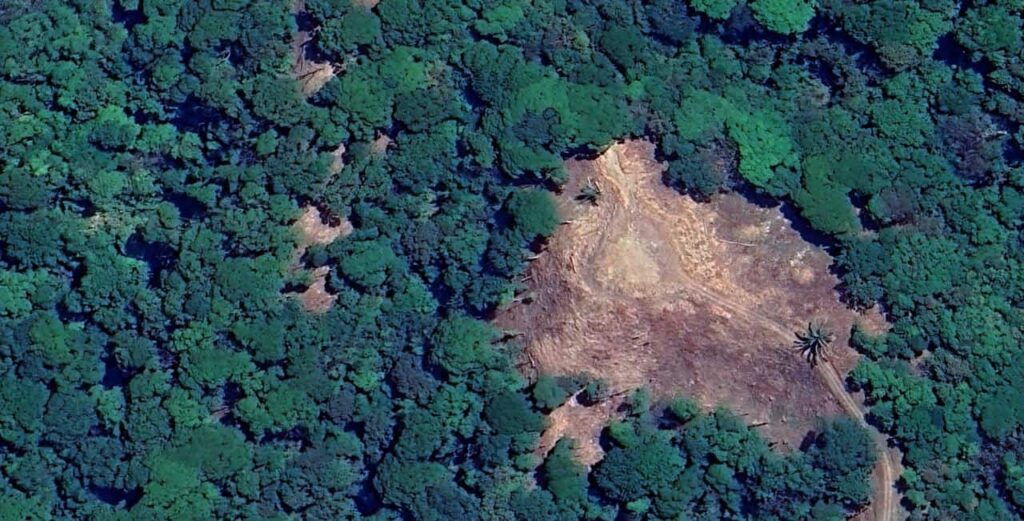
Dominical’s Water Crisis: The Shocking Truth Behind the Illegal Development Project Originally Posted on Tico Times Greed, corruption, land exploitation, and water shortages… these may sound like themes from Roman Polanski’s Chinatown, but the residents of Dominical will tell you that these issues are a reality in their own backyard. This situation is indicative of a larger trend in Costa Rica, where developers openly flaunt environmental laws with little to no consequences for their actions. While El Niño brought lower than normal rainfall to Costa Rica at the beginning of 2024, members of the community in Dominical claim that it is not the weather phenomenon, but rather a development project in the mountains that has caused a series of extended water shortages – the longest of which, on March 22, lasted over 10 hours. Even though Costa Rican law explicitly states that development projects cannot interfere with water supplies, attempts to notify the authorities of the issue in Dominical seemed to be futile. Multiple complaints or denuncias were made through the Ministry of Environment and Energy (MINAE) Integrated System for Processing and Attention to Environmental Complaints (SITADA), but there were reportedly no responses. This led residents to take matters into their own hands by creating a coalition of community members, informally called Water Issues Dominical, to raise awareness of the development project and how it was affecting their water supply. By using flyers to inform home and business owners in town of what was going on, only then were the residents able to raise concern to collectively pressure the landowners and effectively put a halt to the project. However, according to members of the committee, the community is still dealing with the aftermath of the illegal development. The water supplying Dominical originates from a series of natural springs in the mountains above town. These springs are situated on a parcel of land, about 650,000 square meters, and for 80 years this land was owned by a family who allowed the community access to the water source. The water was later “donated” in 2008 to the community and management of the water supply was effectively taken over by the Costa Rican Institute of Aqueducts and Sewers (AyA). Deforested area in mountains above Dominical – provided by Water Issues Dominical The manner in which this water becomes available for consumption in the town of Dominical is through an old-fashioned treatment system, in which the source water first flows down to a tank. It then passes through a filter where sand and other organic matter are removed before it enters a second holding tank. After that, chlorine is added to kill bacteria, but not so much to impact the taste and smell of the water itself. Many of the long-time residents of Dominical will say that this old-school system has provided them with some of the cleanest and best water in all of Costa Rica. Several years back, the owners of the parcel that contained the springs died and the land changed hands a couple of times. According to the Water Issues Dominical committee, the most recent owners used a local who hired Nicaraguan workers to carry out the work of illegally clear-cutting a swath of trees. When AyA instructed them to stop, the workers continued felling trees using axes, rather than chainsaws, presumably because they make less noise. All this was done in the area where the springs that feed Dominical’s water supply are located. Costa Rican law states that all water belongs to the government, whether it be ocean, river, estuary, lake, spring, or even groundwater and no land can be altered within 200 meters from sources of water that serve a public water system. These government-created protection zones exist because having healthy tree coverage is important to clean drinking water. Trees cut down by axes – provided by Water Issues Dominical A reduction in vegetation, due to the felling of trees, causes more erosion, leading to excess sediment entering the streams and rivers. When this water reaches the water treatment system, the increased sedimentation means the system has to be shut off in order for the particles to settle. During this time, the only source of water for consumption comes from the second holding tank, which does not provide enough water to supply the town for an extended period of time. It may take hours for the sediments to settle and for the system to start working again. This all means that in the meantime, homes and businesses are without water. According to AyA, this is exactly what has been happening to Dominical’s water supply. For restaurants in particular, there is a negative financial impact when they are unable to provide their clients with food and drink, not to mention the sanitary services necessary for a functioning establishment. Mariela Céspedes, the Assistant Manager at Mono Congo Cafe, said that during these periods in which Dominical was without water, they couldn’t serve coffee or smoothies to their customers and the only way they were able to stay open at all was because the employees, in anticipation of the shortage, collected enough water in the days prior. Other restaurants that did not collect water were forced to close their doors until the water situation improved. According to Norma Pellot, owner of Café Olas, they had to turn away customers during this time. The same was true for several hotels in town who had to cancel reservations and refund their guests. So if the impact of a single development project can have such an oversized negative impact on an entire community, why doesn’t the municipality get more involved to prevent these issues before they become a problem? Guy Phillips who lives in Escaleras, a community adjacent to Dominical, has investigated this very topic. With a resume that includes a PhD in Environmental Economics and Law from the University of Wisconsin, Professor and Chairman of the Environmental Management Department at the University of California, Riverside, and Assistant Secretary for Resources and Energy for then-Governor of California
How – and Why – to Report Environmental Damage

HOW (AND WHY) TO FILE ENVIRONMENTAL REPORTS Download PDF: English how to file environmental reports Click Here to Download Descarga PDF Aqui: Español cómo presentar informes ambientales Click Aquí Para Descargar Costa Rica has many excellent environmental laws but unfortunately it does not have the resources to effectively enforce those laws. That is where we, concerned citizens, can help. There are several ways we can report our concerns about environmental damage to the proper authorities. There are many actions that are either always illegal, or that require a permit. These include cutting trees, moving earth, setting fires, putting poison in the rivers, and more. When we see such things we have the legal right to report our concerns to the proper authorities. Before we describe how to file such a report (called a “denuncia”), it is important to note that filing a “denuncia” is not an accusation of wrong doing. It is possible that what you are seeing (for example, felled trees or earth movement) has been legally authorized and that the workers/ owners have a legal permit. However, it is also possible that the environmental damage you are seeing is illegal. And it is also possible that the workers have a permit but that it is not the correct one; at least one of our legal actions addresses this kind of situation. It is not your responsibility to determine whether the actions you see are legal or illegal. It is your right – everyone’s right in Costa Rica – to file a denuncia if you see something that concerns you. The denuncia is your way of saying: “I see something that concerns me. I don’t know if it is legal or illegal, but I am asking the proper authorities to check it out.” So, don’t be concerned that filing a denuncia is accusing anyone of anything, because it is not. The best policy is: If you see something, say something by filing a denuncia! BEST PRACTICES FOR COLLECTING EVIDENCE: Ideally you would take pictures and video to document the scene (details below). However, it is not required that you do so. If you are unable to photo document the site, or feel unsafe doing so, please be sure to file a denuncia anyway. Please note that not all methods of filing a denuncia provide a way to upload photos or video. However, your photos and videos may still be useful if there is an investigation of the incident. If you feel safe and are able to document the site, please try to follow these guidelines: Videos and pictures can be instrumental in drawing attention to violations. Often those in the community are better positioned to collect evidence of illegal actions than the professional investigators. This is because the authorities often arrive after-the-fact when the damage is already done or the evidence has been removed or is gone. Ensure your camera or cell phone is set to the correct date, time, and GPS locations so the digital metadata is recorded. Record your voice saying the date, time, and location. If you need to film anonymously, write the time, date and location on a piece of paper and hold it up in front of the camera for 10 seconds. Film strategically! Ask yourself, “If I give this footage to someone not familiar with this location, could they summarize what happened and draw an accurate map of the scene based only on the information in my video or pictures?” You want them to be able to answer, “YES!” Often the WHAT is filmed, but not the WHO and the HOW. It is best to film the entire location continuously, but if the area is too large, complex or dangerous to do so, you can start each new clip or picture by overlapping with the previous one. Drop a location pin in Google Maps so that you have accurate coordinates to share with the authorities (and with Osa Vive) for where the action is taking place. Be sure to collect the following: ✴ A very slow 360-degree pan to provide context and show what is happening behind the scene. ✴ Wide-angle shots to provide context and to identify location ✴ Medium and close-up shots to identify what is taking place ✴ If possible, film each of the shots listed above for 10 seconds or more. Move the camera slowly when you change your position or when you zoom in or out. ✴ Take pictures from different angles to make it easier for officials to identify the location. Include identifying features in the images. If trees are being cut down, it’s important to have imagery that shows a wider area so that locations can be identified later. If you were unable to add basic information to the video recording itself, then create a separate document that summarizes the key information about your visual evidence. Be sure to do this while the details are fresh in your mind. Always include: Date and time you wrote the summary Date, time and location of the filming Names and contact information for the person filming, as well as other people on scene who may have information about the events that took place. (If people wish to remain anonymous, this is okay too.) A short, factual summary of what is shown in the video. Leave out unsupported opinions, misinformation and exaggerations. Now that you have documented the scene here’s what you do with that information There are four ways to file a denuncia. Select one or more that you prefer. 1. Call 911 This can be done in English or Spanish. There is no way to upload photos or video. This may seem like a surprising option if you are from a country that uses the 911 system for emergencies. However, in Costa Rica 911 operators are trained to take environmental denuncias – it is a normal part of their job here. We recommend calling 911 for several reasons: They are on-call 24/7 There are always bilingual
Festival del Día del Océano
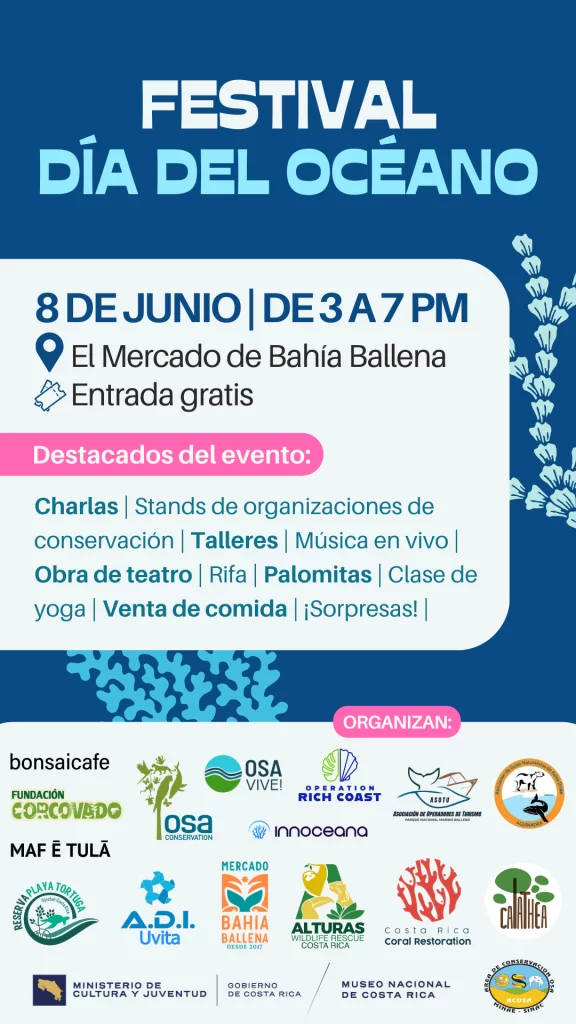
Festival del Día del Océano Date: 6/8/2024 / 8 de Junio Location: El Mecado de Bahia Ballena Time: 3:00PM-8:00PM
Osa Vive’s First Meeting in 2019

OSA VIVE’S FIRST MEETING IN 2019 Fighting the environmental damage caused by irresponsible real estate developments in the southern part of the country is the “Osa Vive!” Association, which residents of Ojochal de Puntarenas and representatives of organizations in the area founded last Friday, May 18. . Nearly 80 people thus committed themselves to the defense of their surrounding forests and mountains, which for years have been victims of massive logging, land surveying and contamination of water sources with sediments as a result of the works carried out in the region. . The residents of Ojochal believe that the development practices of the “Ventana del Pacífico” company are harmful to the environment and threaten nearly 2,000 hectares of territory that includes jungle, mangroves, sections of the Paso de la Danta Biological Corridor (CBPD), beaches of nesting turtles and the ocean that allows whales to mate and procreate annually. Prior to the founding assembly of “Osa Vive!” A visit was made to the affected areas to verify that enormous earthworks, landscape modifications and provoked forest burnings are being carried out. During the meeting, activists and residents of the community shared the episodes of environmental destruction they have witnessed and testified about the threats they have received. A concerned resident of Ojochal commented that phases 9 and 11 of the real estate project are under construction in the area surrounding her house, and that she is concerned about the depth of the excavations. She added that in recent years there have been at least four fires on the land that is being excavated today, one of which forced an evacuation and burned for seven days. “That area was a melina plantation and that is a very difficult tree to eradicate, so they cut them down, then they burn and then the bulldozers come in,” she said. “Where there were trees now there is only dust and the rivers run red with mud.” Company admits having only municipal permitsDuring this meeting, representatives of the developer company “Ventana del Pacífico” appeared and when they were asked if they had permits from the National Environmental Technical Secretariat (Setena) or the Ministry of Environment and Energy for these interventions, they stated that they only had with municipal permits for earthworks. The environmental lawyer Edgardo Araya, who accompanies this process of community organization and who will represent “Osa Vive!” in the legal processes that he will undertake to defend his forests, he commented that after verifying the community’s complaints, the competent authorities in the Minae were informed and that he hopes that they will soon intervene in the area, suspending real estate activities and guaranteeing compliance with national regulations on environmental matters. Araya also commented that as far as it has been investigated, the company “Ventanas del Pacífico”, which presents itself as a real estate company concerned about the environment, is not registered in the country. In fact, he commented, the only company that has managed something on environmental issues in that area is “Eternal Life in the Tropic S.A”, which is viable for the installation of power lines. According to the National Registry, that company has around 100 lots in the area, some of which have already been sold, despite the fact that everything indicates that there are no environmental permits for subdivision and construction. “This could have implications for the credibility of the country to attract healthy investments to the country,” said the lawyer. The association “Osa Vive!” He indicated that he will continue to watch over the well-being of the region’s forests and will take the corresponding legal actions. ORIGINAL ARTICLE FEATURED ON ADIARIO: Vecinos se organizan contra daños ambientales en Ojochal de PuntarenasCerca de 80 personas fundaron la Asociación “Osa Vive!” para defender el bosque y montañas de la zonaColaboración — 21 de mayo de 2019 Combatir el daño ambiental causado por desarrollos inmobiliarios irresponsables en la zona Sur del país es la razón de ser de la Asociación “Osa Vive!”, que personas vecinas de Ojochal de Puntarenas y representantes de organizaciones de la zona fundaron el pasado viernes 18 de mayo. Cerca de 80 personas se comprometieron así con la defensa de sus bosques y montañas circundantes que por años han sido víctimas de la tala masiva de árboles, levantamiento de tierras y contaminación de fuentes de agua con sedimentos producto de las obras que se realizan en la región. Los vecinos y vecinas de Ojochal responsabilizan a la empresa “Ventana del Pacífico” y a su propietaria, Sylvaine Pilault, de amenazar cerca de 2000 hectáreas de territorio que incluye selva, manglar, secciones del Corredor Biológico Paso de la Danta (CBPD), playas de desove de tortugas y el océano que permite a las ballenas aparearse y procrear anualmente. Previo a la asamblea fundacional de “Osa Vive!” se realizó una visita a las zonas afectadas para constatar que se realizan enormes movimientos de tierra, modificaciones del paisaje y quemas de bosque provocadas. Durante la reunión, activistas y vecinos de la comunidad compartieron los episodios de destrucción ambiental que han presenciado y brindaron testimonio de las amenazas que han recibido. Judy Zaun, vecina de Ojochal comentó que en la zona aledaña a su casa se encuentran en construcción las fases 9 y 11 del proyecto inmobiliario, y que le preocupa la profundidad de las excavaciones. Agregó que en los últimos años ha habido al menos cuatro incendios en esos terrenos que hoy se excavan, uno de los cuales obligó a evacuar y ardió por siete días. “Esa zona era una plantación de melina y ese es un árbol muy difícil de erradicar, entonces los cortan, luego se queman y después, entran las excavadoras”, comentó. “Donde había árboles ahora sólo hay polvo y los ríos corren rojos de barro”. Empresa admite tener solamente permisos municipalesEn el transcurso de esta asamblea se presentaron representantes de la empresa desarrolladora “Ventana del Pacífico” y cuando se les consultó si contaban con permisos de la Secretaría Técnica Nacional Ambiental (Setena) o del Ministerio de Ambiente y Energía para estas
OSA VIVE: Why We Started & How To Help

OSA VIVE: WHY WE WERE STARTED & HOW TO HELP Environmental Destruction. We can stop it, but we need you. Our organization, Osa Vive was formed in 2019 to stop illegal development. Chopping trees, then burning and bulldozing the waste into the rivers of Ojochal was a common protocol for one developer. We saw our rainforest, wildlife, rivers, reefs and mangroves quickly being destroyed. Laws, police interventions and legal rulings were ignored and did nothing to deter them. In that year, one particular fire lasted over a week, causing people to evacuate their home while hundreds of acres were destroyed. That large parcel is still being developed today, unless this greed can be legally and morally stopped. This environmental disaster was literally the fire fueled Osa Vive to become a registered Costa Rica nonprofit association. Despite extreme harassment and threats, we have filed lawsuits against this business and the government agencies that turned a blind eye. Legal issues and Covid delayed our plans, but now we’re moving forward stronger than ever. By winning in the courts, we will set an example for other businesses and individuals working in a destructive manner that the community won’t tolerate this kind of irresponsible development. Today, we focus on Ojochal, next we help face the problems of the entire Costa Ballena. Our purpose: Promoting legal, responsible and sustainable growth, while monitoring illegal environmental destruction that is making more than a minimum impact ecologically. We’re not against growth if it’s done while abiding by the laws that are in place to protect the environment. Thankfully, our attorney Edgardo Araya is one of the best environmental lawyers internationally. He is just beginning here and is ready to take on other cases in other areas of the coast. You’ve heard about the problem. Now, let’s talk about the solution. We need your help. Here is how: FUNDRAISING AND DONATIONS. Plan a fundraiser. We are a verified nonprofit organization so all donations are tax write-offs. Easily donate online. Volunteer. Bring your fresh ideas to us. Join Osa Vive as a member or contributor. Commit to attending or zooming in for our meetings. Fluent Spanish speakers are also needed to help with follow-up for legal processes and the government agencies. Share. Submit relevant articles or information to our website or Facebook page. Spread the word by sharing our content with your social network. Monitor. Send photos and details about environmental damage to us. Report illegal activities to the authorities. Our website features exact instructions on what to do for each infraction. Network. Connect and relate your experiences with a like minded community on our anonymous public forum on the website. Directory. Suggest or add businesses that have ecologically evolved. Partner with us. Unite Nonprofit Organizations. We are already working with Coral Reefs Costa Rica, Inoceania, Reserva Playa Tortuga and ASANA. If you belong to one of these groups, attend our meetings to see how we can combine efforts. Should you know of another organization with similar goals, let us know. Media. Send us your publicity contacts with local and international media. We need to get the word out. TOGETHER, let’s protect our precious jewel, the Costa Ballena and its rainforest, rivers, mangroves, reefs and wildlife. WE can stop the destruction with your help. Plans to protect air and water, wilderness and wildlife are in fact plans to protect man. – Stewart Udall Ready To Help Us? Our work is funded by people like you. If you are feeling called to support us today, click the link and help make a difference. Donate Today
Protecting Costa Rica’s Forests and Our Quality of Life
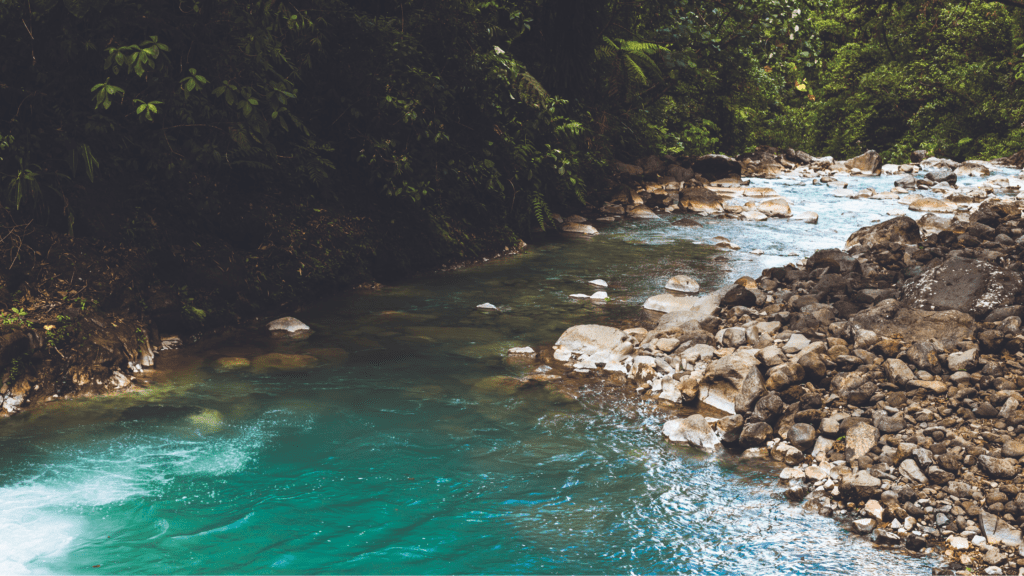
PROTECTING COSTA RICA’S FORESTS AND OUR QUALITY OF LIFE There are many reasons to visit or move to Costa Rica: a stable and peaceful democracy with good health care, a tropical climate and wonderful people. And on top of that, Costa Rica has incredible natural beauty and abundant wildlife. Costa Rica has geology to thank for its stunning biodiversity. Three million years ago a land bridge formed between North and South America, allowing plants and animals from the north to move south and those from the south to move north. As a result, Costa Rica has a double dose of diversity. Consider: Costa Rica is only 5% the size of the United States, and yet it has more species of trees and frogs than does the entire United States! In the 1940’s 75% of Costa Rica was covered with rainforest. Then much of the forest was quickly cut down to grow crops and raise cattle, causing the loss of 50% of the country’s original forests between 1940 and 1983. Almost alone among tropical nations, Costa Rica chose to stop the deforestation and began working to reforest the country. By 2010 forest cover had rebounded from a low of 21% up to 52%. There is still work to do but Costa Rica’s achievement to date is remarkable. Why did Costa Rica commit to reforesting the country? And how did they do it? Costa Rica understood the negative consequences of deforestation: increased greenhouse gas emissions, problems with water quality and management, decreased soil fertility and loss of biodiversity. And Costa Rica recognized that healthy forests full of beautiful tropical animals and plants would bring more tourism dollars to support the Costa Rican economy. Knowing how much the country had to gain, Costa Rica had to figure how to make reforestation a reality. Several factors contributed to the reforestation of the country but two policies from the mid 1990’s stand out, one carrot and one stick. The carrot: Costa Rica began to pay landowners for preserving their land. This system is called Payment for Ecosystem Services, or PES. Landowners are paid for managing their lands to mitigate greenhouse gas emissions, protect water resources, protect biodiversity and preserve scenic natural beauty. Suddenly landowners could benefit financially by preserving their lands (and selectively harvesting specific trees, which the program allows). The average payment of $64 USD per hectare per year has incentivized landowners to protect their forests rather than cut them down. The stick: It became illegal to cut down forest trees without approval from environmental authorities. If anyone wants to cut a forest tree they are legally obligated to contact MINAET and ask for permission. (A future Osa Vive article will provide more detail on this topic.) Thanks to these and other environmental laws and policies, in less than 30 years Costa Rica has seen a significant increase of its forests and the animals that live in them. And reforestation has paid off financially. International visitors are flocking to marvel at Costa Rica’s bountiful nature, bringing 2.2 trillion colones (roughly 3.8 billion USD) to Costa Rica in 2018. Those who live here also benefit from reforestation: we are blessed with an abundance of wildlife every day. But these positive changes are not guaranteed or permanent. Unscrupulous people still cut trees without permission, often knowing that they are acting illegally (hence the sound of chain saws on weekends and holidays, when enforcement is particularly unlikely). People illegally cut forest trees for various reasons: for local use, to open up views, to sell as lumber and for real estate development. Other environmental laws are also routinely violated, including those protecting streams, regulating earth movement, and prohibiting burning. Sadly, there are simply not sufficient funds to properly enforce all of Costa Rica’s excellent environmental laws. Costa Rica has worked hard to rebuild its forests. Those of us who live here have an incredible quality of life thanks to Costa Rica’s efforts. We owe it to our host country – and to ourselves – to help make sure their reforestation efforts are a permanent, ongoing success. Osa Vive is dedicated to ensuring that development occurs in accordance with all Costa Rican environmental laws.